What Is Minimally Invasive
Neurosurgery (MINS)?
Minimally Invasive Neurosurgery (MINS) is an approach to brain surgery that uses small cranial access points, advanced neuronavigation, and specialised instruments — including the brain endoscope — to reach deep brain structures with minimal disruption to the surrounding brain tissue. The core principle is the same as minimally invasive surgery in other specialties: achieve the same surgical result through a smaller entry point, causing less trauma.
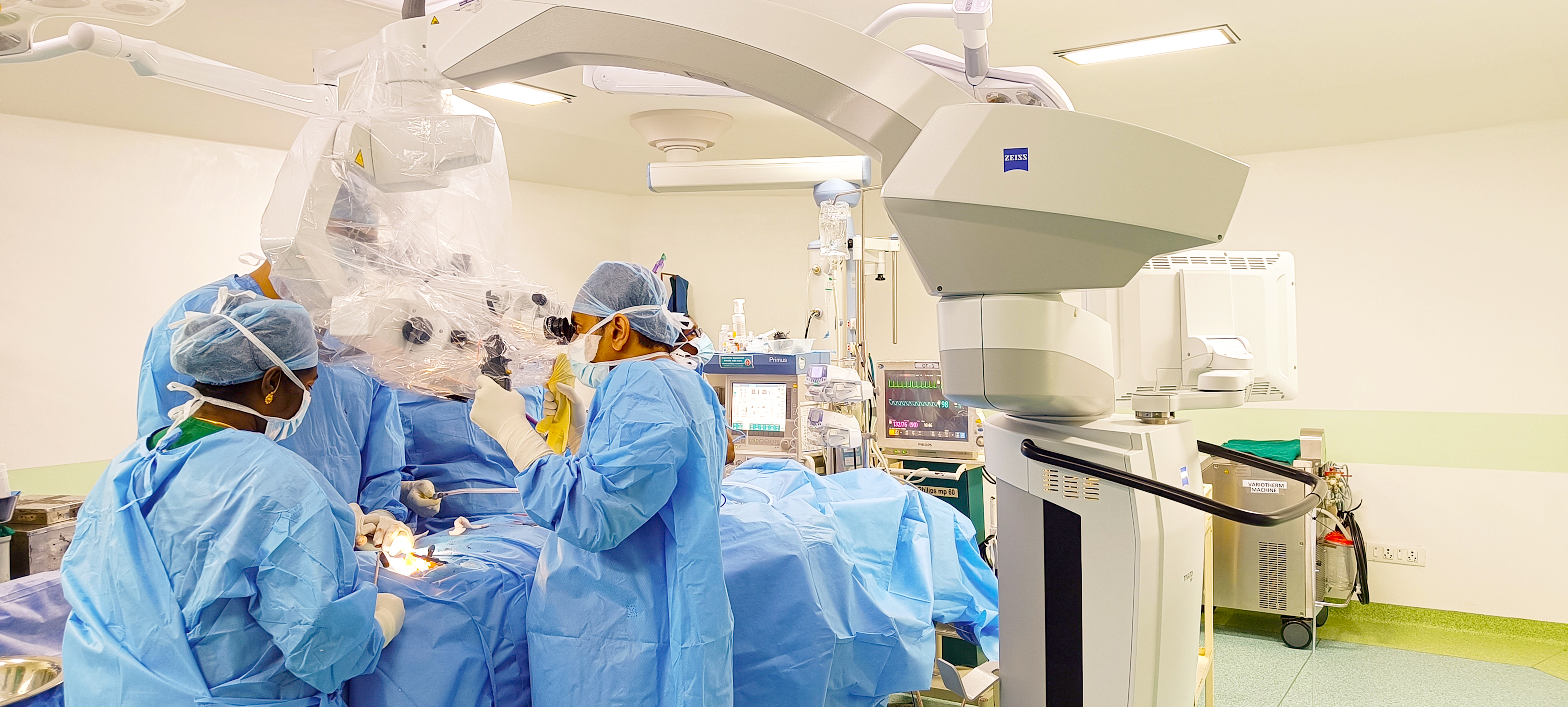
In contrast to traditional open craniotomy — which requires a large flap of skull bone to be removed to access the brain — MINS procedures access the brain through a small keyhole opening, or in endoscopic cases, through the natural corridors of the skull (the nostril, or a tiny burr hole) with a camera and working channel. The surgeon visualises the operative field on a high-definition monitor, guided by the Stryker Neuronavigation System and the TIVATO 700 advanced surgical microscope.
KG Hospital has demonstrated the full potential of MINS by performing it on the youngest patient ever — a 22-day-old premature infant — a global first that no other neurosurgical centre had achieved.
MINS Procedures
at KG Hospital
KG Hospital performs the following minimally invasive and endoscopic neurosurgical procedures. Each avoids the need for large open craniotomy in most cases.
Endoscopic Third Ventriculostomy (ETV)
Shunt-free treatment for obstructive hydrocephalus. A small endoscope creates an opening in the floor of the third ventricle to restore CSF flow. Preferred over VP shunt when anatomy is suitable — avoids life-long shunt dependency and shunt revisions.
Endoscopic Skull Base Surgery
Trans-nasal endoscopic resection of pituitary adenomas, craniopharyngiomas, clival chordomas, and olfactory groove meningiomas. No external incision. Camera and instruments passed through the nostril to access skull base lesions.
Keyhole Brain Tumour Resection
Selected brain tumours — particularly deep-seated lesions and posterior fossa tumours — resected through a small keyhole craniotomy using TIVATO 700 microscope and Stryker Neuronavigation guidance.
Endoscopic Corpus Callosotomy
Minimally invasive disconnection of the corpus callosum for drug-resistant epilepsy with drop attacks (atonic seizures). Faster recovery and less morbidity versus open callosotomy, while achieving comparable seizure reduction.
Endoscopic CSF Rhinorrhea Repair
Sealing of skull base cerebrospinal fluid leaks through the nasal passage under endoscopic guidance. The leak site at the skull base is identified and repaired without external incision. Typically a 1-night stay procedure.
Intraventricular Tumour Excision
Endoscopic access and excision of tumours located inside the brain ventricles (colloid cysts, choroid plexus tumours, ependymomas) without open craniotomy. High-definition endoscope provides direct visualisation of the ventricular system.
Craniosynostosis Correction
Endoscopic strip craniectomy for premature fusion of skull sutures in infants. Corrects head shape and prevents brain compression as the brain grows. Minimally invasive approach suitable for selected infant cases.
Paediatric MINS
Complete paediatric MINS programme — from hydrocephalus and ETV to the world-first case performed on a 22-day-old premature infant. The most demanding paediatric neurosurgical cases accepted and performed.
The World’s First:
MINS on a 22-Day-Old Premature Infant
KG Hospital’s neurosurgery team performed the world’s first Minimally Invasive Neurosurgery on a 22-day-old premature infant — a landmark that had never been achieved at any neurosurgical centre anywhere in the world. This was not simply the youngest MINS patient in India — it was the youngest MINS patient ever recorded globally.
Who Is a Candidate
for MINS?
Not every brain condition requires or benefits from a minimally invasive approach — some conditions are better treated with open craniotomy. A detailed pre-operative MRI and neurosurgical assessment is essential. Below is a general guide to candidacy:
Note: even when full MINS is not possible, keyhole and endoscopy-assisted approaches may reduce the size of craniotomy needed. Our neurosurgeon will advise on the best approach for your specific situation.
Your MINS Patient Journey
at KG Hospital
From consultation to discharge, here is what a typical MINS patient journey looks like at KG Hospital Coimbatore. Timelines vary depending on the specific procedure.
Technology Behind
MINS at KG Hospital
MINS is only as good as the instruments and imaging that support it. KG Hospital’s neurosurgery operation theatre is equipped with the following technology specifically for minimally invasive and endoscopic neurosurgical procedures.